
One Board for an 8-Camera Site: The Interceptor as Switch, Recorder, and Storage
Power cameras on 8 PoE+ ports, run your own VMS, and record to RAID storage, all on one Interceptor board in a 1U case. No vendor cloud in the middle.
A typical small camera site, like a dental office, a storefront, or a storage facility, looks something like this:
A PoE switch for the cameras. An NVR or a small server to record them. A few drives. Power bricks and patch cables tying it all together. It works, but it’s three boxes doing a job one board could do.
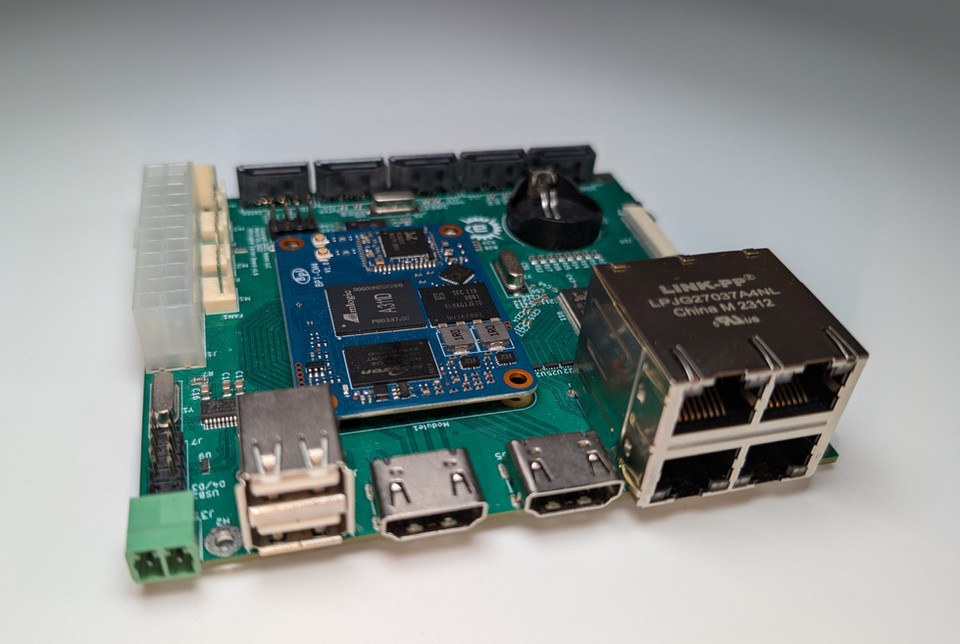
The Exaviz Interceptor is that board. The Interceptor Carrier Board holds a Raspberry Pi Compute Module, five SATA drives, and a 4-port Gigabit switch. Add one Interceptor PoE Board and you have 8 PoE+ camera ports. Your recording software runs on the Compute Module, right next to the ports that power the cameras.
What’s on the board
Interceptor Carrier Board v2.0:
- Raspberry Pi CM4 (full support), Raspberry Pi CM5 (supported, with the limits noted below), or Banana Pi CM4. The compute module is sold separately.
- 5x SATA III (6 Gbps), hot-plug, with RAID 0, 1, 5, 6, or 10 in software (
mdadm) - 4x Gigabit Ethernet through a managed switch (one WAN uplink and three LAN ports by default)
- 2x HDMI 2.0, 4x USB 2.0, RS-485, a micro SD slot, and an RTC with battery backup
- Standard 24-pin ATX power
Interceptor PoE Board:
- 8x PoE+ ports (IEEE 802.3at, up to 30W per port). 802.3af devices work too.
Why one board
- Fewer boxes. The switch, the recorder hardware, and the storage go in one 1U case.
- Your VMS, your OS. It runs standard Raspberry Pi OS with Exaviz’s Debian packages. It’s full Linux, so you pick the recording software.
- No cloud in the middle. Nothing needs an Exaviz account. For remote access, you use the VPN you already run.
- Cameras get addresses right away. Each PoE port gets its own DHCP-served subnet.
Plan before you order
The PoE board runs on 48V from the 48Vdc Power Converter, which supplies up to 240W. That’s enough for 8 ports at 30W, and a basic IP camera draws about 5 to 8W. With PoE boards installed, use a 350W or larger supply. In the 1U case, that’s a Flex ATX unit.
The PoE ports run at 10/100 Mbps and deliver power in Mode B, so each camera run needs a standard 8-wire Cat5e or Cat6 cable. The 4-wire cables bundled with some consumer NVR kits won’t work, and 802.3bt (PoE++) isn’t supported.
The Pi doesn’t boot from SATA, so boot from eMMC or an SD card and keep the drives for recordings. With a CM5, the front-panel button doesn’t power the board on, and you flash the CM5’s eMMC on a separate Raspberry Pi IO Board.
The port count is a design spec, not a measured stream count. Size your VMS, bitrates, and drives for the site, and test on your own hardware before a customer install.
Setup outline
- Seat the CM, then connect the PoE board to J9 with the FFC cable. Lock the clips before you power on.
- Wire the converter from the PSU’s 4+4-pin CPU connector to the PoE board’s terminal block. Never hot-plug 48V.
- Mount everything in the 3HDD 1U case.
- Flash Raspberry Pi OS (64-bit), then install
exaviz-dkms,exaviz-pse-dkms,exaviz-netplan, andexaviz-poe-toolfrom apt.exaviz.com. - Build the RAID array, plug in the cameras, and check that each port is delivering power with
exaviz-poe-tui. - Install your VMS.
Parts list
| Part | Price |
|---|---|
| Interceptor Carrier Board v2.0 | $79 (board only; CM sold separately) |
| Interceptor PoE Board | $59 |
| 48Vdc Power Converter | $19 |
| 350W Power Supply (Flex ATX) | $79 |
| Interceptor 3HDD 1U Case | $134 (holds 3 drives) |
| Raspberry Pi CM4 or CM5, drives, cameras | Sold separately |
What you’ll need: Interceptor carrier + PoE board, a CM4/CM5, the 48Vdc converter, a 350W+ power supply with a stable +3.3V rail, SATA drives, an SD card or eMMC for boot, 8-wire cable for each camera, 802.3af/at cameras that work at 100 Mbps, and your VMS.
We’re also building Exaviz Management, a dashboard that runs on the board itself with no cloud account. More soon. Want to hear when it’s ready? Sign up for announcements.
Both boards are in stock now: the Interceptor Carrier Board v2.0 and the Interceptor PoE Board. Documentation at exa-pedia.com.
Designed by our team in Noblesville, Indiana. NDAA Section 889 (self-attested). Assembly outside China is available on request for customers with country-of-origin requirements.